Psychology & Neurodiversity
4,727,219 members
From human behaviour to neurodiverse perspectives, explore how we think, feel, and experience the world 🧠
@Layla34
We never start if we never start, say Bismillah and take the first step. ✨️
May Allah SWT purify our characters, bless our efforts and take us back to Him in the best of health and eman ameen.
💙 الحمدلله
Astaghfiru'Allah 🤍 📿
# 1st step
# Dua
# One Ummah ☪️
@sweetytweety
A clear sign someone really isn't
Interested in you is that they do not
Ask you questions.
THERE IS NO CURIOSITY.
@Mrfarhanshahzad
The highest level of peace in life is when you reach the stage of:
وَأُفَوِّضُ أَمْرِي إِلَى اللَّهِ
“And I entrust my affairs to Allah.” (Qur’an 40:44)
@shamil667391
📿In this video, Dr. Marwa Assar shares with you the psychological and spiritual power of prioritizing living truthfully and cultivating a sincere identity by knowing who you are when it is just you and God!
🌻Start your journey of inner transformation and
@itsmenadiya
What are your thoughts on marrying someone who is neurodivergent ( ADHD ) whether they're a man or a woman?
@Husyn_mtaphyserenity
ASalaam walaykm, who is awake?
@Zaman47709098
• "I value you a lot, and I would love to be closer friends."
@Naz60739023
What Does It Mean to Be Human in an AI and Robotic World?
AI vs. Human: The Future of Script Analysis - Filmustage Blog
In a world increasingly shaped by artificial intelligence and robots, being human means more than being intelligent, productive, or capable of solving problems. It means being able to feel, to care, to question, to imagine, to make moral choices, and to find meaning in our existence.
AI can analyse information. Robots can perform tasks. Machines can sometimes imitate human conversation, creativity, and emotion. But this raises a profound question:
If machines can do many of the things that once made us feel unique, what makes us human?
I think the answer lies not only in what we can do, but in how we experience life and how we treat one another.
1. Our ability to feel and connect
What to Say When Someone Is Losing a Loved One: A Supportive Guide | Ahead App Blog
Human life is built on relationships. We love, grieve, forgive, feel lonely, and find comfort in the presence of others.
An AI may recognise sadness and respond with comforting words, but recognising an emotion is not necessarily the same as experiencing it.
Being human means that our relationships carry personal histories, vulnerability, memories, and emotional consequences.
Sometimes, a simple gesture—a hand on someone's shoulder, sitting quietly beside a grieving friend, or listening without judgment—has a meaning that goes beyond words or efficiency.
Technology can imitate the language of care, but we must never forget the importance of genuinely caring for one another.
2. Our imperfections make us human
Machines are often designed to reduce errors. Humans, however, learn through mistakes, uncertainty, and failure.
We change our minds. We contradict ourselves. We make poor decisions and sometimes discover wisdom through regret.
Our imperfections are not always weaknesses. They can teach us humility, patience, empathy, and forgiveness.
In a world that increasingly values speed, accuracy, and optimisation, being human may mean accepting that not everything valuable can be perfected.
We do not have to be flawless to have worth.
3. Our freedom to question and choose
AI can generate answers, compare possibilities, and recommend decisions. But human beings must still ask what is worth pursuing and what consequences we are willing to accept.
Should we build a technology simply because we can?
Should efficiency matter more than dignity?
Should a machine make a decision that affects someone's freedom, future, or livelihood?
These are not merely technical questions. They are ethical questions.
Being human means taking responsibility for our choices rather than surrendering our judgment to machines.
4. Our search for meaning
The Power of Hope: Understanding its Role in Positive Psychology
A machine can be programmed to pursue a goal. Human beings can question the goal itself.
We wonder why we exist, what makes a life meaningful, what happens when we die, and what we owe to future generations.
We create art, tell stories, develop beliefs, explore the universe, and search for meaning even when there are no easy answers.
Perhaps one of the most human things we do is ask questions for which we cannot be certain of the answers.
AI may help us explore these questions, but it does not remove our responsibility to live them.
5. When intelligence is no longer uniquely human
For a long time, intelligence was one of the main qualities we used to distinguish ourselves from other beings. Now, AI challenges that assumption.
Machines can write poems, compose music, analyse medical images, and solve difficult problems. Robots may increasingly perform physical work that humans once considered uniquely ours.
This challenges us to reconsider a dangerous belief: that our value depends on what we produce.
If a machine can do your job faster, does that make your life less valuable?
Of course not.
Your worth is not simply your economic contribution, your intelligence, your qualifications, or your usefulness to society.
A human being is not a machine whose value is measured by performance.
We must build a future in which technology serves human dignity rather than making human dignity conditional on productivity.
6. What should remain human in a robotic world?
The goal should not necessarily be to compete with machines at everything. It should be to decide what kind of world we want machines to help us create.
| What technology can help us do | What we must continue to take responsibility for |
|---|---|
| Process information | Decide what information matters |
| Automate work | Protect human dignity and livelihoods |
| Simulate conversation | Build meaningful relationships |
| Generate creative ideas | Explore what we want to express and why |
| Predict outcomes | Make ethical choices under uncertainty |
| Increase efficiency | Decide what is worth doing in the first place |
These boundaries will not always be simple. AI may become increasingly capable, and we should remain open-minded about what future systems might experience or understand.
But whatever machines become capable of, we remain responsible for the values, institutions, and relationships that shape our shared future.
7. Perhaps being human will become even more important
About Us | A Mindful Resource Inc. — Built for Us. By Us.
Imagine a future where robots perform most routine work, AI provides instant information, and machines can produce almost anything we need.
What will matter then?
Perhaps we will have to rediscover the value of spending time with loved ones, caring for children and older people, protecting nature, creating things without needing to sell them, and having conversations that do not need to lead to a result.
Perhaps the question will shift from How much can I achieve? to What kind of life is worth living?
Technology might free us from some burdens, but it cannot automatically tell us what to do with that freedom.
That choice remains a profoundly human challenge.
My final thought
Being human in an AI and robotic world does not mean resisting technology or pretending that humans are superior in every possible way.
It means developing technology without losing sight of the people it is meant to serve.
It means remembering that intelligence without wisdom can be dangerous, progress without compassion can be cruel, and efficiency without purpose can leave us empty.
Above all, it means recognising that our humanity is not something we need to defend by proving that machines cannot do what we do.
It is something we express through the way we live, the choices we make, the relationships we nurture, and the future we create together.
Perhaps the greatest challenge of the AI age is not teaching machines to become more human. It is ensuring that, as our machines become more intelligent, we do not become less human.
And I would leave you with one question:
If one day machines could think faster than us, work better than us, create like us, and speak almost exactly like us, would we still know what makes our lives meaningful?
Because perhaps the future of humanity depends less on whether machines can become like us, and more on whether we understand what being human truly means.
@Naz60739023
What are time and space? Can life exist outside time?
These are some of the deepest questions we can ask about existence. And the fascinating thing is that science can explain some parts of the answer, while other parts remain genuinely unknown.
Let's explore this step by step.
1. What is time? ⏳
The Illusion of Time: How Physics Challenges Our Perception of Past, Present, and Future | by HAI_Shakers | Medium
We experience time as a movement from the past, through the present, into the future.
You were a child. You are here now. You will grow older. We call this the passage of time.
But physics reveals something surprising: time does not pass at the same rate for everyone.
According to Einstein's theory of relativity:
- -The faster you travel relative to another observer, the more slowly your time passes compared with theirs.
- -Stronger gravity also makes time pass more slowly relative to clocks farther away from the gravitational field.
These effects have been measured experimentally. Time is not simply one universal clock ticking identically throughout the cosmos.
But what is time, fundamentally?
Physicists often treat it as a dimension that helps describe when events happen, just as spatial dimensions describe where they happen.
Yet we still do not have a universally accepted answer to why time exists at all, or why we experience it as flowing.
Here is the strange part: the equations of physics describe relationships between events, but the feeling that we are moving from moment to moment is a further question.
Is time flowing, or are we experiencing reality in a way that makes it seem to flow? That is still a subject of philosophical and scientific debate.
2. What is space? 🌌
What Is the Cosmic Web? James Webb Just Made the Clearest
Space is not necessarily an empty box in which the universe sits.
In Einstein's theory of general relativity, space and time form a combined structure called spacetime. Matter and energy influence its geometry, and that geometry influences how objects move.
Imagine Earth orbiting the Sun. The Sun's mass changes the geometry of spacetime around it, helping explain Earth's orbit.
Even what we call empty space has physical properties. Quantum field theory describes fields that exist throughout space, including regions with no ordinary matter.
But this leads to another profound question:
If the universe is expanding, what is it expanding into?
The standard cosmological picture does not require the universe to expand into some larger, empty space. Space itself can expand. If the universe is infinite, it may already be infinite; if it is finite, it may have a geometry without an ordinary outer edge.
We do not yet know the universe's complete global structure.
And we do not know whether space and time are fundamental ingredients of reality or emerge from something more basic.
3. Does life exist outside time?
This is the most mysterious part of your question.
The honest answer is that we do not know whether life or consciousness can exist outside time. But we can explore what it would mean.
First, consider what life normally involves:
- -Change: a living organism develops.
- -Memory: it retains information about what happened.
- -Experience: it has different states, sensations, or responses.
- -Process: its body carries out biological activities.
All these things seem to involve time.
A tree grows. Your heart beats. A thought arises and another follows. Even the experience of reading this sentence unfolds moment by moment.
If something exists completely outside time, it would not experience one moment followed by another in the ordinary sense.
So we face a fascinating question: Could something be alive without changing, without experiencing a sequence of moments, and without having a before or after?
We have no confirmed scientific example of such life.
However, there are several ways to think about it.
Scientists discover a major brain shift between ages 50 and 75 | ScienceDaily
Possibility 1: Consciousness requires time
Our brains change from moment to moment. Memories form, sensations arise, and thoughts develop. This suggests that ordinary human consciousness depends on physical processes occurring in time.
We have no established evidence that human consciousness can operate independently of these processes.
Welcome to Spacetime!. If spacetime sounds like it is… | by Fred Jones | Medium
Possibility 2: Time may not be fundamental
Some approaches to fundamental physics explore whether time could emerge from a deeper description of reality. In that case, what we experience as time might not be a basic ingredient of the universe.
But this does not demonstrate that consciousness or life exists outside time. NASA Science
+1
日常のすべてを気功にする|ゾルク
Possibility 3: Timeless existence
Some philosophical and religious traditions propose that reality, or a divine being, can exist beyond time.
In these traditions, timelessness does not mean living for an infinite number of years. It means not experiencing existence as a sequence of moments at all. This is a philosophical or theological idea, not an established scientific finding. Stanford Encyclopedia of Philosophy
+1
4. What if the past, present, and future all exist?
Zaman Bir Yanılsama mı? Einstein’ın "Blok Evren" Teorisi Algılarımızı Zorluyor - Atom & Evren
Here is one of the strangest ideas in the philosophy of physics.
Imagine your life as a complete book.
- -One page describes your childhood.
- -Another describes today.
- -Another describes a moment decades from now.
When you read the book, you encounter the pages one after another. But the book contains all its pages, not just the one you are reading.
Some interpretations of relativity inspire a similar picture called the block universe: past, present, and future events may all be part of a four-dimensional spacetime structure.
This is a serious philosophical interpretation of physics, although its implications are debated. It does not mean that we have proved the future is fixed or that human choices are meaningless. Stanford Encyclopedia of Philosophy
+1
Now consider something even more fascinating.
If the block universe picture is correct, your childhood would not necessarily be something that has simply vanished from reality. It would be an event located at a different time in spacetime.
You cannot return to it merely by remembering it, but the philosophical question of whether the past still exists is more complicated than it first appears.
And this raises another question:
Are we moving through time, or are we conscious beings experiencing one part of a larger reality at a time?
We do not yet have a definitive answer.
5. Could the universe exist without time?
Think about the universe before the Big Bang.
The Big Bang theory describes the evolution of the early universe from an extremely hot, dense state. But when we ask what happened before the Big Bang, we encounter the limits of our current understanding.
In the standard cosmological model, our familiar description of the universe traces back to an early hot, dense phase. What, if anything, preceded that phase remains unresolved.
Some theoretical models explore a prior universe, a cosmic bounce, or other possibilities. Others raise the possibility that the ordinary concept of "before" may not apply in the usual way.
The important distinction is this:
- -We do not know whether time began absolutely.
- -We do not know whether something existed before the Big Bang.
- -We do not know whether reality can exist without time.
And if time itself began with the universe, asking what happened before time might be like asking what lies north of the North Pole. The question assumes a framework that may no longer apply.
That is a possibility, not a settled conclusion.
6. If there is no time, is there any existence?
Let's take the question to its deepest level.
Imagine a reality in which nothing changes. Nothing begins. Nothing ends. There is no yesterday, today, or tomorrow.
Would that reality exist?
Perhaps. But what would it mean for something to exist if there were no change, no duration, and no events?
We usually recognise existence through interactions, observations, and relationships between things. A timeless reality might not fit our ordinary concepts of existence at all.
There is also a difference between existing forever and existing outside time.
- -Existing forever means continuing through an unlimited duration.
- -Existing outside time means not having a temporal duration in the ordinary sense.
Those are fundamentally different ideas.
And if consciousness requires a succession of experiences, timeless consciousness may be difficult even to imagine. Perhaps the limitation lies in reality itself, or perhaps it lies in the way our time-dependent minds understand reality.
We cannot yet tell.
7. The question I find most fascinating
You began by asking what it means to be human in a world of AI and robots. Now you are asking about time, space, and whether life can exist beyond them.
These questions connect in a profound way.
AI challenges us to ask what intelligence is. Consciousness challenges us to ask what experience is. Physics challenges us to ask what reality is. And timelessness challenges us to ask whether our ordinary understanding of existence is complete.
Here is a thought experiment.
Imagine that a being exists outside time. It does not age, wait, remember yesterday, or anticipate tomorrow. It does not move from one experience to another.
Would such a being be conscious?
Would it be alive?
Would it even make sense to call it a being?
We have no definitive answers. But exploring these questions helps reveal how much we still do not understand about existence.
@rijal
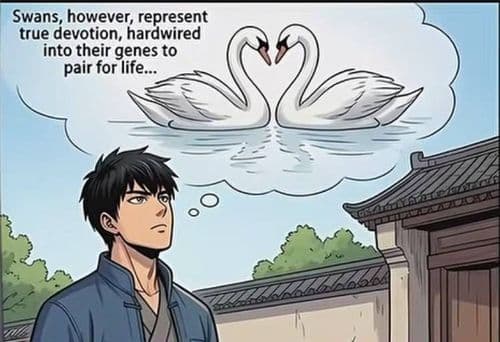
"Human were never designed for lifelong monogamy. Some manage it but only after enduring significant life experiences. True love requires the right soil. What people call devotion is often just the lingering regret of a missed connection from one's youth.
True love is forged through shared life-and-death trials building deep trust and physical intimacy claims that love is independent of money ignore reality. Economic foundations dictate everything and men seek thrills while
women prioritize stability. No one is truly noble concepts. Like eternal love are myths and remarriage after a spouse's death is common.
swans however represent true devotion hardwired into their genes to pair for life without needing grand dramatic trials."