
Psychology & Neurodiversity
4,727,024 members
From human behaviour to neurodiverse perspectives, explore how we think, feel, and experience the world 🧠
@PoeticJustice
Butterflies Won’t Pay The Bills 💰🦋
With all this talk about wanting butterflies, chemistry and that elusive spark before getting married, I’ve got a question.
How important are these feelings when it comes to actually sustaining a marriage, fid-dunya wal-akhirah?
Don’t get me wrong, butterflies and chemistry are lovely, but they’re certainly not what keeps a marriage going when life gets tough.
Islam gives us three beautiful foundations for marriage:
❤️ Sakinah: Tranquillity
❤️ Mawaddah: Affectionate love
❤️ Rahmah: Mercy
Allah ﷻ says:
“And among His signs is that He created for you spouses from among yourselves so that you may find comfort in them. And He has placed between you compassion and mercy.”
(Surah Ar-Rum (30:21))
Not a single mention of butterflies, fireworks or electric shocks from the Lord of the Worlds! Instead, Allah speaks of peace, love and mercy.
Now, before anyone accuses me of promoting boring marriages where the highlight of your evening is deciding whose turn it is to empty the dishwasher, hear me out! 🤣
Butterflies are a feeling, not a foundation. They’re often a mixture of excitement, anticipation, nervousness and attraction.
And whilst there’s absolutely nothing wrong with feeling them, they’re hardly a reliable compatibility test, are they? You can have butterflies with someone who’s completely wrong for you.
Equally, you can feel comfortable, safe and emotionally connected to someone without your stomach performing Olympic-level gymnastics every time they message you! 🤸♀️🤣
And here’s something worth thinking about. Sometimes what we mistake for a lack of chemistry is simply the absence of anxiety.
But does attraction matter?
<CUSTOM_BOLD>Of course it does!
Islam doesn’t dismiss physical attraction or romantic desire. In fact, the Prophet ﷺ encouraged prospective spouses to look at one another because it could help foster affection between them.
(Jamiʿ at-Tirmidhi 1087)
After all, you’re looking for a husband or wife, not a flatmate to split the council tax and argue over the thermostat with! 🤣
But attraction and chemistry aren’t necessarily the same thing. Chemistry can be instant, whereas genuine attraction can grow through kindness, understanding, emotional connection and mutual respect.
You don’t need fireworks on your first meeting, but there should be some attraction and a willingness to get to know one another.
And this is where I think we’re getting our priorities mixed up.
We’re so busy asking ourselves how someone makes us feel that we sometimes forget to ask who they actually are.
What’s their relationship with Allah like?
How’s their character?
Can they communicate without turning every disagreement into World War III?
Can they admit they’re wrong without needing a solicitor present? 🤭
Are they patient, considerate and emotionally mature?
Because let’s be realistic.
Butterflies won’t resolve your arguments. Chemistry won’t pay your bills. And that spark won’t suddenly turn someone with poor character into a wonderful spouse.
You might have enough chemistry to open your own laboratory, but what happens when the honeymoon period ends and real life comes knocking? 🧪🤣
When you’re exhausted?
When finances are tight?
When illness strikes?
When you’re both getting on each other’s nerves?
When your spouse isn’t exactly winning the Husband or Wife of the Year award that particular day?
That’s when those three beautiful qualities mentioned in the Qur’an really matter.
❤️ Sakinah
Knowing you can be yourself without constantly walking on eggshells. Being able to disagree without disrespecting one another. Feeling safe, understood and at peace in someone’s presence.
❤️ Mawaddah
Love isn’t just about saying those three little words. It’s about showing it. Remembering how your spouse likes their coffee.
Noticing when they’re tired.
Listening when they’ve had a difficult day. Doing the little things without expecting a standing ovation every time! 👏
❤️ Rahmah
Mercy. And this, for me, is where the real beauty of marriage lies. Because real love doesn’t just show up when everything’s sunshine, roses and romantic dinners. Real love shows up when life tests you to your limits. When you’re struggling, exhausted or at rock bottom.
It’s the person who stands beside you when things get difficult, rather than suddenly developing disappearing skills that would put Houdini to shame! 🤭
The one who chooses patience over anger, kindness over harshness and understanding over judgement.
The one who reminds you of Allah when your heart feels heavy. Because anyone can be loving when life’s going swimmingly and nobody’s getting on anyone’s nerves! But loving someone through life’s difficulties? That’s where character, commitment and mercy really show themselves.
And before anyone thinks I’m suggesting we marry someone we’re not attracted to, absolutely not! Attraction matters. Romance matters. Emotional intimacy matters. Nobody’s suggesting a marriage where the only sparks flying are from a faulty toaster! 🤣
But here’s the thing. Before nikah, you’re getting to know someone based on what you’ve seen of their character. It’s only after marriage, when you begin sharing the everyday realities of life, that you discover deeper sides of one another.
You might fall in love with who you believe someone is before nikah, but it’s through marriage that you learn what loving that person really involves.
And sometimes the most beautiful love isn’t the one that starts with fireworks.
It’s the one that grows in the background through friendship, trust, laughter, affection and countless little acts of kindness.
Don’t confuse the intensity of a connection with the depth of its potential.
Butterflies might make your heart race, but sakinah allows it to rest. Chemistry might make you want to spend every waking moment together, but character helps you navigate a lifetime together.
And let’s not forget, we’re not just looking for someone to share a few exciting years with in this dunya. We’re looking for someone who will help us grow in our deen, bring us closer to Allah and, by His mercy, become our companion in Jannah.
So perhaps instead of only asking:
“<CUSTOM_BOLD>Do they give me
butterflies?”🦋
We should also be asking:
“<CUSTOM_BOLD>Do they bring me peace?”
“Can we disagree without declaring war?”
“Will we show each other mercy when life gets difficult?”
And most importantly:
“Will this person help me become someone Allah is pleased with?”
Because butterflies are beautiful, but they’re not a marriage strategy. +And chemistry without having character? Well, that’s just a chemical reaction waiting to blow up in your face!🧪💥🤣
So I’m curious. 🤔
Are we putting too much emphasis on finding that initial spark and overlooking the qualities that actually keep a marriage alive?
Or do you think butterflies and instant chemistry are essential before saying </CUSTOM_BOLD>Qubool Hai?
Because butterflies eventually settle, but a love built on sakinah, mawaddah and rahmah? That’s the kind of love that has wings of its own. 🦋❤️*
https://www.theuntangledself.com/p/the-chemistry-lie-why-butterflies
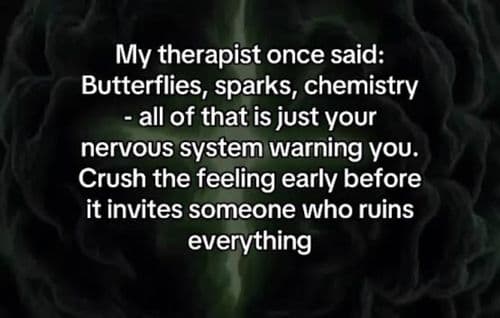

The Chemistry Lie: Why Butterflies Make Terrible Relationship Advisors
https://www.theuntangledself.com/p/the-chemistry-lie-why-butterflies
Some mates tell me that a little bit of toxicity in a relationship is healthy and it keep the relationship alive, but I feel like I just want peace like I’m getting to old for toxic traits and childish behaviour, like I understand arguments are bond to happen but I just choose peace and understanding over toxic any day of the week, what do you guys prefer?
@Amani31
You can't become truly happy by thinking only of yourself.
Most people seek happiness as though it were something to accumulate.
More money.
More comfort.
More experiences.
"The more I possess, the happier I become."
But the soul does not follow the laws of economics.
If you give away $50, you have less.
If you share your joy, you often have more.
Imagine accomplishing something meaningful.
Now imagine telling someone who genuinely rejoices in your success.
Their happiness does not diminish yours.
It deepens it.
Your joy awakens joy in them, and their response returns to you like warmth from a second flame.
This is why joy differs from material wealth:
A candle loses nothing by lighting another candle.
Yet the room becomes brighter.
Human happiness works in much the same way.
A teacher delighting in a student's growth.
Friends celebrating one another's achievements without envy.
A community united by a meaningful ideal.
Dr Steiner describes a profound relationship:
Love → Joy → Understanding
Love awakens joy.
Joy opens us to the world.
And an open soul develops the capacity to understand both life and other human beings.
The selfish person asks:
"What can the world give me?"
The loving person gradually learns to ask:
"What can I rejoice in?"
Not only in himself.
But in truth.
Beauty.
The successes of others.
The good wherever it appears.
And in doing so, he discovers something remarkable:
The sources of happiness become almost limitless.
Perhaps one of life's greatest mistakes is believing that happiness must first be acquired.
Often, deeper happiness is found in what we give, celebrate, and awaken in others.
A flame does not become poorer by lighting another.
And a human soul does not become poorer by bringing warmth into the lives of others.
Happiness grows most when it stops being something we try to possess.
@lilyOzcivit
Happy Saturday 🥰✨
@Mrfarhanshahzad
Sabr doesn't mean you're not hurting.
Rasulullah ﷺ wept when his son Ibrahim died. He grieved, yet he remained patient.
You can hate your circumstances, cry over your losses, and still trust Allah.
Patience isn't the absence of pain. It's choosing to remain faithful through it.
@khadizhah
Gentleness is a Flex.
Being cold isn't masculinity... it's weakness.
The Prophet Muhammad SAW and Ali (R.A)
Were the strongest of men
And the Softest in Love
@valentinaisha
Beyond the Pyramid: The Encounter Between Need and the Sacred
Abraham Maslow taught us that once human beings are nourished and safe, they feel the call of the other. We need faces, words shared around a table, visits that interrupt solitude, and a group in which to recognize ourselves. For Western psychology, the social bond is the answer to an internal lack, a fundamental building block for the fulfillment of the Self.
But when this same need meets the Islamic sphere, the perspective flips and elevates.
In Islam, the relationship with the other is not merely a need to be satisfied, but an act of worship to be offered. The presence of the brother, the friend, the family, and the community (Ummah) serves not only to fill the individual's void, but to reflect the divine. Time spent talking, sharing food, and visiting one another are not just cultural habits or social necessities: they become silent prayer when carried out "for the love of God" (Fi Sabilillah).
If for psychology the community supports the individual on their journey to the top of the pyramid, in the Islamic vision the community is the body itself : if one limb suffers, the whole body responds with wakefulness and fever (Hadith).
Thus, what for science is a natural human necessity, for spirituality becomes the bridge to the Transcendent: we do not seek the other simply because we need them, but because in the other we find the path to perfecting our soul.
@sk431382
Feeling like a hypocrite after slipping up is exhausting. But that guilt isn't proof that your faith is broken—it’s actually a Quranic stage of spiritual growth. 🤍
Islamic psychology describes the nafs (the inner self) across three primary states:
Level 1: Nafs al-Ammara (Surah Yusuf 12:53) — Sin Without Resistance
Pattern: Sins happen often with minimal internal friction.
Mindset: Rationalization, denial, or shifting blame.
Growth: Stalled, because healing cannot begin where denial lives.
Level 2: Nafs al-Lawwama (Surah Al-Qiyamah 75:2) — The Self-Reproaching Soul
Pattern: You slip, but you fight back and feel the weight of it.
Mindset: "I know I messed up." Your heart and conscience are actively alive.
Growth: Constant effort—fall, regret, reset. The trap here is drowning in shame instead of turning to tawbah (repentance).
Level 3: Nafs al-Mutma'inna (Surah Al-Fajr 89:27) — The Soul at Rest
Pattern: Urges are recognized early; mistakes are met with immediate return.
Mindset: Grounded self-honesty without paralyzing self-hatred.
Growth: Consistent tazkiyah (soul purification). Still human, never infallible.
Spiritual maturity isn’t sinlessness; it’s closing the gap between making a mistake and turning back to Allah. 🌿
Which stage resonates most with your current season? Comment 1, 2, or 3 below.
If you feel trapped in a continuous loop of sin, guilt, and shame, 1:1 Islamic psychology counselling sessions are open. DM "HEALING" 🤍
@haymish
A Global Question for the Ladies Around the World
In your experience, are men fundamentally the same regardless of where they come from, or do you believe that attitudes, values, and behaviour differ significantly from one country to another ?
Are certain traits universal, or does culture and family dynamics shape the kind of men you encounter and the relationships you experience ?
Ladies, share your experiences, exchange insights, and feel free to compare notes with other women from other parts of the world.
Is it a matter of religion, culture, character, environment, or simply human nature ?
