Psychology & Neurodiversity
4,727,024 members
From human behaviour to neurodiverse perspectives, explore how we think, feel, and experience the world 🧠
@valentinaisha
Science, Psychology, and Faith: What Lies Behind Love, Affection, and sexual intercourse ❤️🫂
When we talk about love, we tend to reduce it to a simple, fleeting emotion. But psychology, neuroscience, and great spiritual traditions tell us a much deeper story: human beings are literally hardwired for connection.
What actually happens inside us—both biologically and spiritually—when we love?
The Map of Love: From Psychology to Neurochemistry
Great thinkers of the 20th century sought to decode this mystery:
John Bowlby showed that the need for affection (attachment theory) is not a luxury, but a primary survival need.
Erich Fromm reminded us that love is not just a feeling we "fall" into, but an active art that requires maturity and dedication.
Robert Sternberg broke it down into three essential ingredients: intimacy, passion, and commitment.
On a cerebral level, all of this translates into a true natural pharmacy:
Falling in love is an explosion of dopamine and norepinephrine (euphoria, a racing heart, a relentless fixation on the other person).
Long-term affection and **** trigger oxytocin and endorphins , our natural soothing agents. They reduce stress, lower blood pressure, create a profound sense of security, and strengthen the bond of partnership through shared pleasure.
The Parallel with Islam: Mawaddah and Rahma
It is striking to notice how modern science does nothing more than confirm what spirituality codified centuries ago. In the Quran (Surah Ar-Rum, 30:21), speaking of marriage and the bond between partners, an extraordinary verse describes the very essence of mature love through two key concepts:
"And among His signs is this, that He created for you mates from among yourselves, that you may find tranquility in them, and He has placed between you Mawaddah and Rahma."
In Islamic exegesis, these two words encompass the entire anatomy of a healthy relationship:
Mawaddah ( المودة ): Passionate love, warm affection, desire, and physical and emotional closeness. This corresponds to the phase of chemistry, passion, and the joy of being together.
Rahma ( الرحمة ): Mercy, deep compassion, and tenderness. This is what takes over when initial passion evolves; it is the capacity to forgive, to care for one another in times of vulnerability, and to protect each other. It is precisely what neurobiology calls a secure attachment and the release of oxytocin.
Furthermore, Islam places sexuality within marriage not as a taboo, but as a blessed act of closeness—a channel of affection that nourishes the body and consolidates the soul, confirming that physical pleasure and emotional bonding go hand in hand.
Food for Thought
Today, we tend to confuse love solely with the chemical phase of falling in love: we expect the initial "spark" to last forever, and at the first sign of difficulty, we often throw everything away.
Yet psychology teaches us that lasting love requires work and maturity, and the Islamic tradition reminds us that the true key to stability lies in the balance between passion ( Mawaddah ) and compassionate care ( Rahma* ).
And you? Do you think that today we give too much space to initial chemistry and too little to the patient building of deep affection?
@Rayyan7z
Understanding the root cause for all/any type of problems is simple. Anyone want to share their thoughts on what's the root cause?
@Nana555
As a woman, I find this reminder important. I believe the beauty of a man's leadership lies in his willingness to carry responsibility with justice, gentleness, and fear of Allah—not merely in expecting others to recognise his authority.
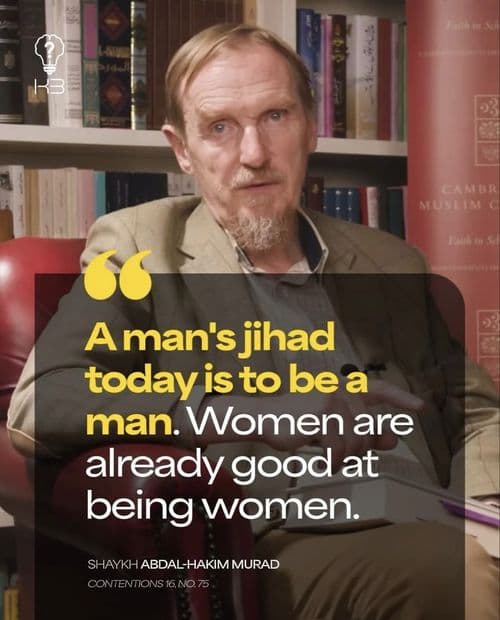
“A man's jihad today is to be a man. Women are already good at being women.”
— Shaykh Abdal-Hakim Murad
Contentions 16, no. 75
Commentary
One of the defining confusions of our age is the meaning of manhood itself. Feminism and liberal individualism have challenged traditional male and female roles, often portraying the responsibilities of manhood as oppressive and individual freedom as incompatible with duty. In the pursuit of sameness, the question of what a man owes others is overshadowed by what he believes he is entitled to claim.
Yet, equality does not require interchangeability. As Shaykh Murad writes:
“Male and female cannot be equal, for they are mutually superior.”
— Contentions 7, no. 31
Men and women need not be identical to possess dignity; their differences carry meaning, and their responsibilities matter.
As the Qur'an states:
“Men are caretakers of women.”
— Qur'an 4:34
This is a trust, not a licence for domination. A man cannot claim authority while evading responsibility, demand respect while neglecting his duties, or insist upon his rights while disregarding those of others. His role demands provision, protection, and accountability before Allah.
Manhood is not measured by status or bravado, but by discipline, courage, integrity, and the willingness to bear hardship when duty demands it. Strength must serve responsibility, and leadership must be exercised with justice and mercy.
The jihad of manhood is to resist the confusion of the age, conquer one's weaknesses, and fulfil the responsibilities Allah has entrusted to men. It is to lead without tyranny, protect without arrogance, and honour one's duties before demanding one's rights.
Manhood is not a privilege to claim, but a trust for which every man will answer before Allah.
@SDear
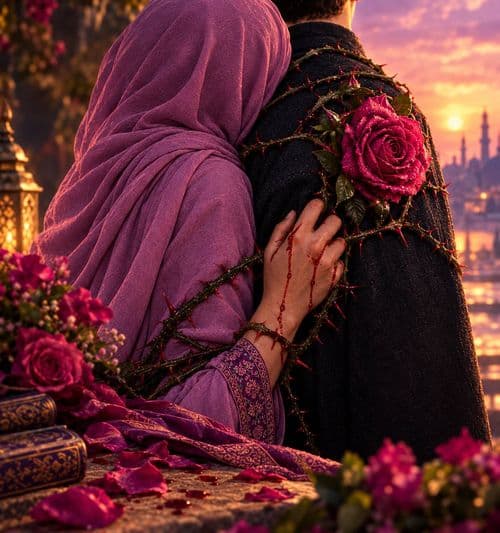
When You at This Image What do you Interpret?
@annaaaa_f
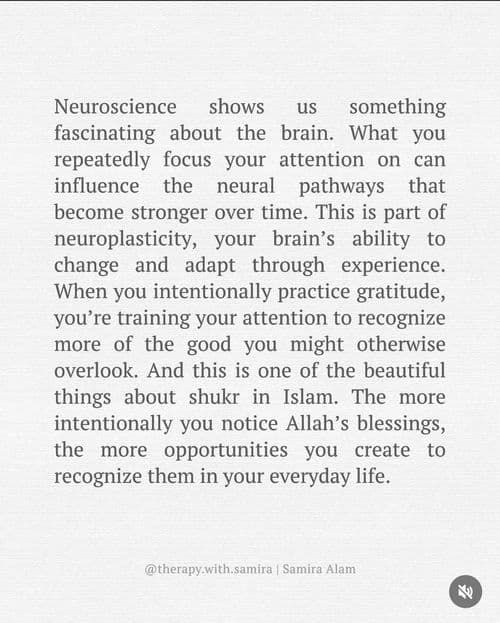
Just as intentionally focusing on Allah’s blessings helps us recognise the good in our lives, constantly exposing ourselves to negativity can gradually distort our perception of the world. It can foster distrust, resentment and fear, eventually making us believe that we must control others or maintain the upper hand to protect ourselves. Ultimately, we risk taking it upon ourselves to control what is not ours to control, forgetting that Allah is the One in control of all affairs.
Social media algorithms can further reinforce this cycle by repeatedly showing us content that aligns with what we engage with, potentially creating an increasingly negative perception of the world. This is why we must be mindful of what we constantly expose ourselves to.
One of the best ways to counter this is to consistently read the Quran, ponder over its meanings and allow Allah’s words to shape how we see the world, rather than allowing the world to shape our hearts. The more we reflect on His guidance, the better equipped we become to recognise our own shortcomings, exercise justice towards others and place our trust in Allah rather than our own desire for control.
@lilyOzcivit
Never ever depend on a man for financial stability. Develop your talents and full potential and make bank so that you achieve your lifestyle and able to focus what matters to you in life without the chains of answering to someone else. Don't let any man determine your dunia and akhirah.
That is Real Freedom.
@Mrfarhanshahzad
A Sin Nobody Talks About Enough ⚠️
Backbiting can feel like a casual conversation, but Allah warns us against it in the Qur’an.
Protect someone's honor when they're not around.
— Qur’an 49:12
@EeSsMmAa
Knowing your worth means staying true to yourself.
Never compromise who you are just to earn everyone’s love. Never make yourself smaller just to be accepted, and never become a stranger to your own soul just to avoid being alone.
Because betraying yourself often begins with the fear of losing others. 🌿
@haymish
Exemplified by the legend that is…
Have you ever experienced a moment in life when every fibre of your being urged you to unleash your inner Cantona, yet you chose instead to walk away in silence ?
Feel free to acknowledge through a simple nod, or even use this space to dissipate if you need to.
@seleno_reader
You become so afraid of suffering that you accidentally create a life entirely shaped by it
What's shaping up your life currently?