Islam
social.group.members
🕋 Spirituality, hadiths, Islamic history and teachings. Connect with fellow members in enlightening conversations as we seek a deeper understanding and appreciation of Islam.
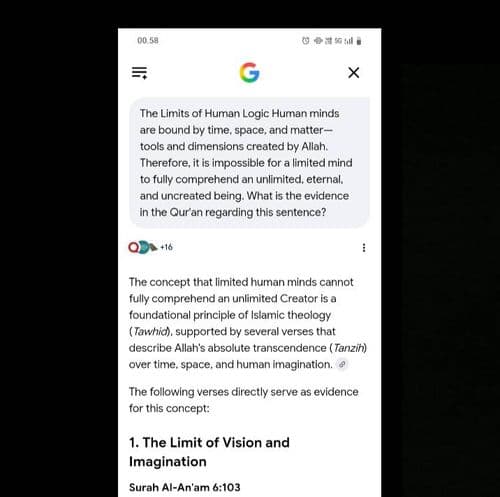
🗣️✨✨The Limits of Human Logic Human minds are bound by time, space, and matter—tools and dimensions created by Allah. Therefore, it is impossible for a limited mind to fully comprehend an unlimited, eternal, and uncreated being. What is the evidence in the Qur'an regarding this sentence?
The concept that limited human minds cannot fully comprehend an unlimited Creator is a foundational principle of Islamic theology (Tawhid), supported by several verses that describe Allah's absolute transcendence (Tanzih) over time, space, and human imagination.
The following verses directly serve as evidence for this concept:
- The Limit of Vision and Imagination
Surah Al-An'am 6:103
"No vision can encompass Him, but He encompasses all vision. For He is the Most Subtle, All-Aware."
The Evidence: The Arabic word for "encompass" (tudriquhu) means to fully grasp, contain, or completely see. This verse explicitly states that human sight—and by extension, the human mind which builds images from what we can see—cannot fully grasp or contain the essence of Allah.
-
The Uniqueness of the Creator
Surah Ash-Shura 42:11
"...There is nothing like unto Him, and He is the All-Hearing, All-Seeing."
The Evidence: Because Allah is entirely unique and unlike anything else in existence, the human mind, which can only conceptualize based on worldly experiences (time, space, and matter), has no baseline or reference to fully comprehend His uncreated Essence. -
The Limits of Human Knowledge
Surah Ta-Ha 20:110
"...But they cannot encompass Him in their knowledge."
The Evidence: This highlights the finite capacity of human intellect. Just as we are bound by material dimensions, our knowledge is restricted, making it impossible for our finite thoughts to contain the infinite nature of Allah. -
Allah as Timeless and Uncreated
Surah Al-Hadid 57:3
"He is the First and the Last, the Manifest and the Hidden, and He has knowledge of everything."
The Evidence: By being the "First" (with no beginning) and the "Last" (with no end), Allah exists outside the bounds of time, a dimension He created for His creation. Because human logic operates linearly within time, grasping a timeless existence is beyond our cognitive capacity.
- What We Can Comprehend
While we cannot comprehend Allah's absolute essence, the Qur'an encourages us to understand His existence and Majesty through His creation, His names, and His attributes (such as His Mercy, Power, and Justice):
Surah Ta-Ha 20:110
"...He knows what is before them and what is behind them, but they cannot encompass Him in knowledge."
➖➖➖➖➖➖➖➖➖➖➖➖➖➖➖➖
✨https://share.google/aimode/WBS5slG8TjXRvhP9E
➖➖➖➖➖➖➖➖➖➖➖➖➖➖➖➖
What Is Ibadah (Worship)?
One of the biggest misunderstandings today is that many people think worship means only praying, fasting, making dhikr, reading the Quran, or sitting in a mosque.
But Islam teaches something much deeper and far more beautiful.
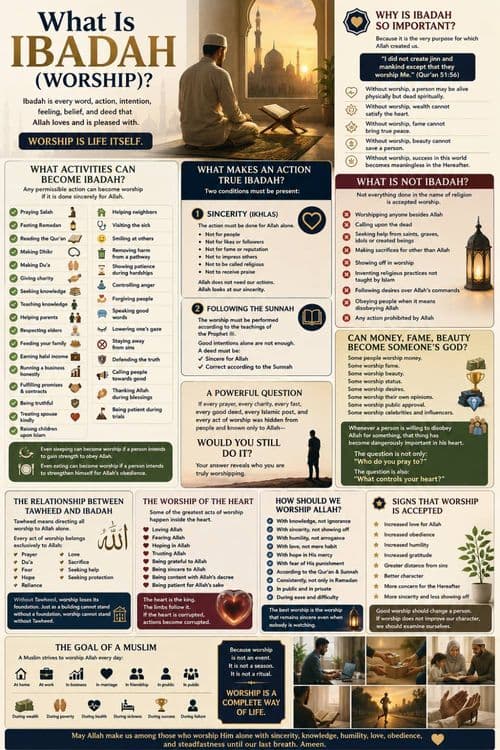
Ibadah is every word, action, intention, feeling, belief, and deed that Allah loves and is pleased with.
Worship is not a part of life.
Worship is life itself.
Why Is Ibadah So Important?
Because it is the very purpose for which Allah created us.
Allah says:
"I did not create jinn and mankind except that they worship Me." (Quran 51:56)
We were not created merely to eat, sleep, work, earn money, chase desires, seek entertainment, grow old, and die.
We were created to know Allah, worship Allah, obey Allah, love Allah, and submit to Allah.
Without worship, a person may be alive physically but dead spiritually.
Without worship, wealth cannot satisfy the heart.
Without worship, fame cannot bring true peace.
Without worship, beauty cannot save a person.
Without worship, success in this world becomes meaningless in the Hereafter.
What Does Worship Mean?
Worship means complete submission, humility, love, obedience, hope, fear, trust, and devotion directed to Allah alone.
It is not merely what the body does.
It is also what the heart believes.
The tongue may say words of worship while the heart is attached to something else.
True worship begins in the heart and appears through actions.
What Activities Can Become Ibadah?
Any permissible action can become worship if it is done sincerely for Allah.
Examples include:
Praying Salah
Fasting Ramadan
Reading the Quran
Making Dhikr
Making Dua
Giving charity
Seeking knowledge
Teaching beneficial knowledge
Helping parents
Respecting elders
Feeding your family
Earning halal income
Running a business honestly
Fulfilling contracts and promises
Being truthful
Treating your spouse kindly
Raising children upon Islam
Helping neighbors
Visiting the sick
Smiling at others
Removing harm from a pathway
Showing patience during hardships
Controlling anger
Forgiving people
Speaking good words
Lowering one's gaze
Staying away from sins
Defending the truth
Calling people towards good
Thanking Allah during blessings
Being patient during trials
Even sleeping can become worship if a person intends to gain strength to obey Allah.
Even eating can become worship if a person intends to strengthen himself for Allah's obedience.
What Makes An Action True Ibadah?
Two conditions must be present:
- Sincerity (Ikhlas)
The action must be done for Allah alone.
Not for people.
Not for likes.
Not for followers.
Not for fame.
Not for reputation.
Not to impress others.
Not to be called religious.
Not to receive praise.
Allah does not need our actions.
Allah looks at our sincerity.
- Following The Sunnah
The worship must be performed according to the teachings of the Prophet ﷺ.
Good intentions alone are not enough.
A person cannot invent his own forms of worship and expect them to be accepted.
A deed must be:
Sincere for Allah
Correct according to the Sunnah
What Is NOT Ibadah?
Not everything done in the name of religion is accepted worship.
Examples include:
✗ Worshipping anyone besides Allah
✗ Calling upon the dead
✗ Seeking divine help from saints, graves, idols, or created beings
✗ Making sacrifices for other than Allah
✗ Showing off in worship
✗ Inventing religious practices not taught by Islam
✗ Following desires over Allah's commands
✗ Obeying people when it means disobeying Allah
✗ Any action prohibited by Allah
Can Money Become Someone's God?
Many people claim to worship Allah with their tongues while their hearts worship something else.
Some worship money.
Some worship fame.
Some worship beauty.
Some worship status.
Some worship desires.
Some worship their own opinions.
Some worship public approval.
Some worship celebrities and influencers.
Whenever a person is willing to disobey Allah for something, that thing has become dangerously important in his heart.
The question is not only:
"Who do you pray to?"
The question is also:
"What controls your heart?"
The Relationship Between Tawheed And Ibadah
Tawheed means directing all worship to Allah alone.
Every act of worship belongs exclusively to Allah:
Prayer
Dua
Fear
Hope
Reliance
Love
Sacrifice
Seeking ultimate help
Seeking protection
Without Tawheed, worship loses its foundation.
Just as a building cannot stand without a foundation, worship cannot stand without Tawheed.
The Worship Of The Heart
Many people focus only on physical acts of worship.
But some of the greatest acts of worship happen inside the heart.
Examples:
Loving Allah
Fearing Allah
Hoping in Allah
Trusting Allah
Being grateful to Allah
Being sincere to Allah
Being content with Allah's decree
Being patient for Allah's sake
The heart is the king.
The limbs follow it.
If the heart is corrupted, actions become corrupted.
How Should We Worship Allah?
We worship Allah:
With knowledge, not ignorance
With sincerity, not showing off
With humility, not arrogance
With love, not mere habit
With hope in His mercy
With fear of His punishment
According to the Qur'an and Sunnah
Consistently, not only during Ramadan or hardships
In public and in private
During ease and difficulty
The best worship is the worship that remains sincere even when nobody is watching.
Signs That Worship Is Accepted
While only Allah truly knows, some signs include:
Increased love for Allah
Increased obedience
Increased humility
Increased gratitude
Greater distance from sins
Better character
More concern for the Hereafter
More sincerity and less showing off
Good worship should change a person.
If worship does not improve our character, we should examine ourselves.
A Powerful Question
If every prayer, every charity, every fast, every good deed, every Islamic post, and every act of worship was hidden from people and known only to Allah
Would you still do it?
Your answer reveals who you are truly worshipping.
The Goal Of A Muslim
A Muslim does not worship Allah only in Ramadan.
A Muslim does not worship Allah only in the mosque.
A Muslim does not remember Allah only when life becomes difficult.
A Muslim strives to worship Allah every day:
At home.
At work.
In business.
In marriage.
In friendship.
In private.
In public.
During wealth.
During poverty.
During health.
During sickness.
During success.
During failure.
Because worship is not an event.
It is not a season.
It is not a ritual.
Worship is a complete way of life.
And the greatest honor a human being can ever have is to be a sincere servant of Allah.
May Allah make us among those who worship Him alone with sincerity, knowledge, humility, love, obedience, and steadfastness until our last breath.
Ameen.
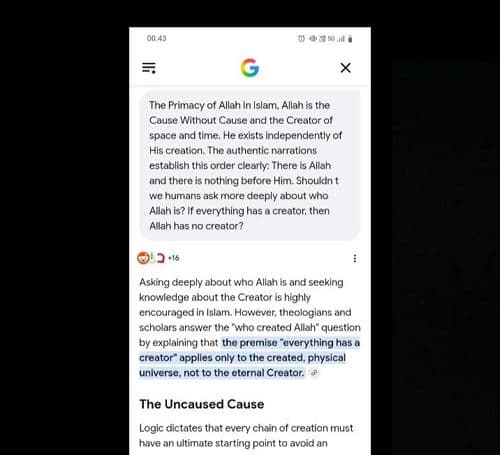
🗣️🗣️"The Primacy of Allah In Islam, Allah is the Cause Without Cause and the Creator of space and time. He exists independently of His creation. The authentic narrations establish this order clearly: There is Allah and there is nothing before Him. Shouldn t we humans ask more deeply about who Allah is? If everything has a creator, then Allah has no creator?
Asking deeply about who Allah is and seeking knowledge about the Creator is highly encouraged in Islam. However, theologians and scholars answer the "who created Allah" question by explaining that the premise "everything has a creator" applies only to the created, physical universe, not to the eternal Creator"
➖➖➖➖
✔️The Uncaused Cause
Logic dictates that every chain of creation must have an ultimate starting point to avoid an endless loop of creators (an infinite regress). In Islamic theology, Allah is that Uncaused First Cause.
Because He is the Originator of the universe, He is independent of it, and the physical laws of cause and effect do not apply to Him.
The Nature of Allah
The Quran explicitly establishes Allah's unique, eternal nature. In Surah Al-Ikhlas (112:1-4), it is stated:
"Say, He is Allah, [who is] One. Allah, the Eternal Refuge. He neither begets nor is born. Nor is there to Him any equivalent."
Because He is Al-Awwal (The First) and As-Samad (The Eternal, Self-Sufficient), He has no beginning and no need for a creator.
The Limits of Human Logic
Human minds are bound by time, space, and matter—tools and dimensions created by Allah. Therefore, it is impossible for a limited mind to fully comprehend an unlimited, eternal, and uncreated being.
Prophet Muhammad (peace be upon him) even warned that the devil might whisper such inquiries to humans to instill doubt. He advised that when the thought of "who created Allah" occurs to a believer, they should seek refuge in Allah and stop pursuing that specific line of questioning, as it applies the rules of creation to the Creato
✨✨https://share.google/aimode/ilwc459Tvp2ZSXVtk
➖➖➖➖➖➖➖➖➖➖➖➖➖➖➖➖
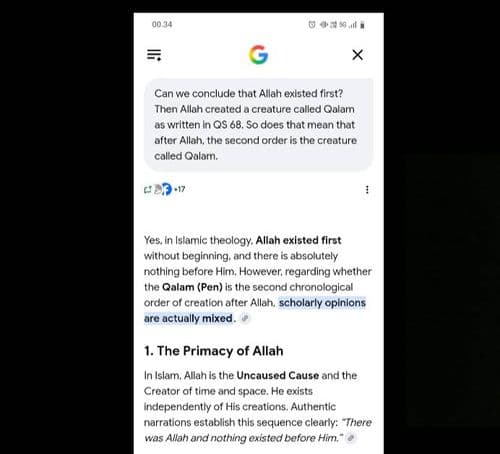
✔️🗣️Can we conclude that Allah existed first? Then Allah created a creature called Qalam as written in QS 68. So does that mean that after Allah, the second order is the creature called Qalam.
✔️Yes, in Islamic theology, Allah existed first without beginning, and there is absolutely nothing before Him. However, regarding whether the Qalam (Pen) is the second chronological order of creation after Allah, scholarly opinions are actually mixed.
-
The Primacy of Allah
In Islam, Allah is the Uncaused Cause and the Creator of time and space. He exists independently of His creations. Authentic narrations establish this sequence clearly: “There was Allah and nothing existed before Him.” -
Differing Views on the First Creation
Islamic scholars have debated what specific entity was created immediately after Allah, primarily interpreting references in the Quran and the Hadith. Opinions on the sequence differ:
The Qalam (Pen): Many scholars conclude the Qalam was the first creation. This is based on Hadith where the Prophet Muhammad (PBUH) stated: "Verily, the first to be created by Allah was the pen. Allah told it to write, so it wrote all that will exist until forever."
The Throne (Al-Arsh) and Water: Other prominent scholars and commentators on Hadith argue that the Throne and Water were created before the Pen. This conclusion is drawn from narrations stating Allah's Throne was above the water before He created the heavens and the earth.
The Light (Noor) of Prophet Muhammad: Many believers hold the view that the spiritual light of the Prophet was created first, from which other matters were subsequently fashioned.
- Understanding the Quranic Mention (Surah Al-Qalam 68)
Surah Al-Qalam opens with the letter Nun and the phrase: "By the pen and what they write." This is an oath used by Allah to emphasize the importance of writing, knowledge, and the divine decrees. It is not a sequential timeline of creation itself, but rather an introduction to the message revealed to the Prophet.
For a deeper dive into the consensus and differing scholarly perspectives on the order of creation, you can explore the detailed commentary on this topic found in the Islam Question & Answer analysis.
Perhaps the Ghurabā’ are not a legend after all.
They may be the ones silently choosing Allah when the world chooses desires.
They may be the ones praying Fajr while everyone else sleeps.
They may be the ones lowering their gaze while others normalize temptation.
They may be the ones holding onto the Sunnah while being called “extreme,” “backward,” or “too religious.”
The Prophet ﷺ said:
“Islam began as something strange and it will return to being strange as it began, so glad tidings to the strangers.”
Perhaps being a stranger is not a punishment.
Perhaps it is an honour.
In an age where truth is voted on, where morality changes with trends and where likes are valued more than revelation, holding firmly to the Qur’an and Sunnah can feel lonely.
But remember:
Every prophet stood against the majority.
Every reformer was mocked before he was respected.
Every believer will stand alone before Allah.
Do not measure your path by the number walking with you.
Measure it by whether it leads to Allah.
The ghurabā’ are not those seeking attention.
They are the ones seeking His pleasure.
Quietly.
Patiently.
Sincerely.
And if one day you feel alone because you refuse to compromise your deen, perhaps that loneliness is not abandonment.
Perhaps it is Allah preserving you.
Perhaps the world sees them as strangers because they are walking home while everyone else is wandering.
“So glad tidings to the strangers.”
اللهم اجعلنا منهم.
O Allah, make us among them. 🤲