لا إلهَ إِلَّا اللَّهُ مُحَمَّدٌ رَسُولُ اللَّهِ
اَللّٰهُمَّ صَلِّ عَلٰى مُحَمَّدٍ وَعَلٰى اٰلِ مُحَمَّدٍ
Assalamualaikum....
Bismillahirrahmanirrahim....
🗣️🗣️What problems will arise if the Islamic ummah is influenced by the Ahmadiyya ideology of Mirza Ghulam Ahmad?
🗣️🗣️If the global Islamic ummah were heavily influenced by the Ahmadiyya ideology of Mirza Ghulam Ahmad, it would cause severe theological ruptures and widespread sociopolitical upheaval. This is primarily because core Ahmadi beliefs—such as the continuation of prophethood after Prophet Muhammad and the spiritual return of Jesus (rather than his bodily return)—directly contradict the foundational tenets of mainstream Sunni and Shia Islam.
The most significant problems that would arise include:
Theological Fragmentation: Mainstream Islam uniformly holds that Prophet Muhammad is the absolute "Seal of the Prophets" (Khatam an-Nabiyyin). Accepting the Ahmadiyya concept of "subordinate prophets" would invalidate established mainstream consensus on Islamic creed (Aqidah).
Schism and Mass Excommunication (Takfir): Traditional Islamic scholarship views claiming prophethood after Muhammad as an act of apostasy. If Ahmadiyya ideology gains influence, it would likely result in deep structural schisms, reciprocal excommunication, and intense theological conflict between orthodox Muslims and those embracing the new ideology.
Reinterpretation of Eschatology: Mainstream Islamic doctrine anticipates a literal, bodily return of Jesus and the physical appearance of a Mahdi. Ahmadiyya ideology dictates that Jesus survived the crucifixion, died a natural death in Kashmir, and that Mirza Ghulam Ahmad fulfilled the roles of both the Mahdi and Messiah. This would dismantle traditional views of the end times.
Shifting Legal and Political Frameworks: Many Muslim-majority nations have strict constitutional and legal definitions of prophethood that govern religious rights and statehood (such as in Pakistan). Embracing Ahmadi ideology would require radical overhauls of these foundational state doctrines, likely resulting in systemic political destabilization.
Contention over Jihad: Ahmadiyya theology heavily emphasizes peaceful, spiritual jihad and largely rejects the necessity of armed conflict. Influencing the global ummah with this pacifist interpretation would lead to intense debates and friction with orthodox schools of jurisprudence (Fiqh) that recognize the legitimacy of armed self-defense in certain contexts.
Given the deep-seated historical and theological differences between the Ahmadiyya movement and mainstream Islam, bridging these divides would fundamentally alter the structure of Islamic belief.
https://share.google/aimode/zaSAb8ZjFQ7E9q3dQ
➖➖➖➖➖➖➖➖➖➖➖➖➖➖➖➖
➖➖➖➖➖➖➖➖➖➖➖➖➖➖➖➖
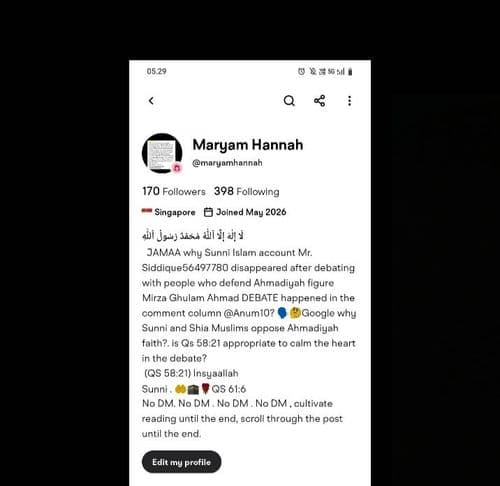
🗣️🤲🌹I am a Sunni Muslim, search on Google whether QS 58:21 is suitable to apply to calm the heart (When debating with people who follow the Ahmadiyya faith of Mirza Ghulam Ahmad?), why did Allah SWT reveal that verse.
✔️🤲🌹Yes, QS 58:21 is highly suitable for calming the heart, as it provides a powerful divine reassurance of the ultimate triumph of Allah and His messengers.
The text of Surah Al-Mujadilah (58:21) states:
كَتَبَ اللَّهُ لَأَغْلِبَنَّ أَنَا وَرُسُلِي ۚ إِنَّ اللَّهَ قَوِيٌّ عَزِيزٌ
"Allah has decreed: 'I will surely overcome, I and My messengers.' Indeed, Allah is Powerful and Exalted in Might."
Here is a breakdown of why this verse brings tranquility during theological discussions and the historical reason for its revelation.
How It Calms the Heart During Discussions
When interacting with followers of the Ahmadiyya faith (who believe Mirza Ghulam Ahmad was a promised messiah or prophet), discussions can sometimes cause internal distress or anxiety for a Sunni Muslim trying to defend orthodox beliefs. Reciting and reflecting on this verse calms the heart in three ways:
Affirmation of Absolute Truth: It shifts your focus away from the human anxiety of winning a debate and anchors your heart to a fixed divine reality—that Allah's true message always prevails over any theological deviations.
Confidence in Finality: Classic Sunni tafsir (exegesis) notes that the "messengers" (rusul) mentioned here are those sent by Allah with absolute truth. For Sunni Muslims, this reinforces the finality of Prophet Muhammad (ﷺ) as the Khatam an-Nabiyyin (Seal of the Prophets), bringing peace that no subsequent claim to prophethood can alter this divine decree.
Removal of Intellectual Despair: It reminds you that the responsibility to guide hearts belongs to Allah alone. Your role is simply to convey truth calmly and with good manners, trusting that Allah's truth is inherently invincible.
Why Allah Revealed This Verse (Asbab al-Nuzul)
According to classical commentators like Tafsir Ibn Kathir and Tafsir Al-Jalalayn, this verse was revealed in Madinah to address the psychological state of both the believers and the hypocrites (Munafiqoon):
Reassuring the Outnumbered Believers: During the Madinan period, the early Muslim community faced constant threats from powerful surrounding tribes, the Roman and Persian empires, and internal subversion. Some companions wondered how they could survive such overwhelming odds. Allah revealed this verse to firmly establish that victory is determined by divine decree, not by numbers or material wealth.
Exposing the Defeatism of the Hypocrites: The hypocrites within Madinah secretly allied with adversaries, believing that the Prophet (ﷺ) and his companions would eventually be destroyed. Allah revealed this verse to shatter their calculations, openly declaring that those who oppose Allah and His Messenger are destined for humiliation, while Allah’s side is destined for victory.
Practical Advice for Discussions
While QS 58:21 is excellent for internal peace, Islamic scholarship emphasizes pairing it with the Quranic methodology of dialogue found in Surah An-Nahl (16:125): "Invite to the way of your Lord with wisdom and good instruction, and argue with them in a way that is best."
Keeping your heart calm through remembrance (dhikr) allows you to maintain the exemplary manners (akhlaq) of the Prophet (ﷺ) during complex conversations.
6 hari yang lalu