Islam
15,356,497 members
🕋 Spirituality, hadiths, Islamic history and teachings. Connect with fellow members in enlightening conversations as we seek a deeper understanding and appreciation of Islam.
@Veravhe
We often view luxury as the most impressive thing in life. Yet, it’s usually the simplest things that carry the deepest blessings.
Effortless breathing, a deep and peaceful sleep, a refreshing drink when thirsty, a friendly greeting from someone, being able to taste and enjoy food, and feeling safe while walking outside. They’re all quiet reminders of His endless grace.
As repeated so beautifully in Surah Ar-Rahman, we are constantly reminded of how abundant His blessings truly are. Allah Subhanahu Wa Ta’ala said:
فَبِاَ يِّ اٰلَآ ءِ رَبِّكُمَا تُكَذِّبٰنِ
Fabi-ayyi ala-i rabbikuma tukazziban.
Which of the favors of your Lord will you deny?
Sometimes we’re so focused on what’s missing that we forget to appreciate what’s already right in front of us.
Take a moment to pause today...what’s one simple thing you’re grateful for right now? 🤍
@Samer15901457
Good morning 🌞
@HassanRaza102
The Science: Modern geology confirms that iron did not form on Earth. It requires the extreme energy of exploding stars (supernovas) in deep space to form, and was carried to Earth by meteorites.
The Quran: Specifies that iron was sent down from above:
...And We sent down iron, wherein is great military might and benefits for the people... (Surah Al-Hadid, 57:25)
@Hisham17627362
Good morning 🙏 🌄 ☺️, the best duaa is from the Quran,
when you hear it you're ❤️ heart smiles.
Have wonderful day.
@Zulaikhakure
Assalamualaikum warahmatullahi wabarakatuhu
Don't forget to seek forgiveness from Allah! Allah will always merciful 🤍
@rdwn454174
May Allah guides us in right path Aneen...🤲
@Aidah28091935
Bismillah 🤲
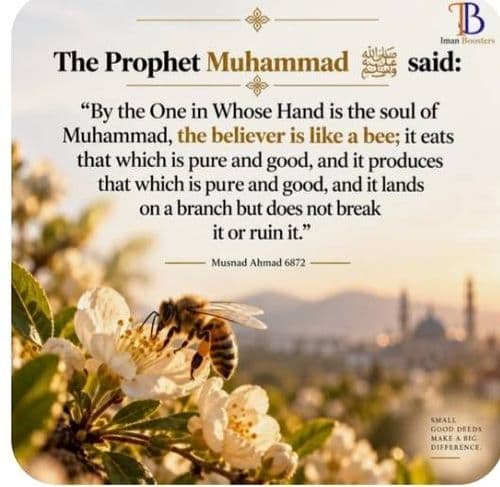
The Believer — Like a Bee
The Prophet ﷺ gave us the most beautiful example: the believer is like a bee.
It feeds only on what is pure and good — so too does the believer choose what enters their heart, body, and mind. It produces only what is pure and sweet — so too do your words and deeds bring goodness to all. And wherever it rests, it leaves no harm behind — it does not break the branch, does not spoil the flower. So too should you: walk gently, touch nothing with cruelty, and leave every place and person better than you found them.
To be a true believer is to be a source of goodness — in what you take, in what you give, and in every step you take. 🤲✨
@Nisa32520226
Im 43 years old how old are you in this years 👌??
@Omer60912241
I search devorce girl
03076781061, Whatsapp
@AlexanderTheLate
Brothers (Sisters you may also answer but keep in mind this is a strictly Islamic History post), I would like to hear who your favorite and most respected Muslim (s) is in history? If you cannot choose 1 you may name up to 3 Mumineen. All I ask for in your response is honesty and respect. It can from Sahaba era or may even be past century historic Muslims such as Malcolm X, Muhammad Ali, or you can go back as far into history as our father Nabi Adam (AS).
A few qualifications to consider for your choice should be chivalry, integrity, Emaan, steadfastness, intelligence, and most importantly devotion to Allah SWT our Master and Creator (AZWJ) and His (SWT) Final Messenger, Prophet Muhammad (SAWA).
I have chosen Imam Ali Ibn Abi Talib (AS), his son Aba Abdillah, Saydi Shuhada, Imam Hussain (ASWS) and Zayd Ibn Ali (The Martyr, AS). I believe these were the three most impactful and bravest Muslim men in terms of self sacrifice for Almighty God.
Zayd The Martyr, May Allah SWT pour blessings upon you O' Zayd, named by the Holy Prophet (SAWA)