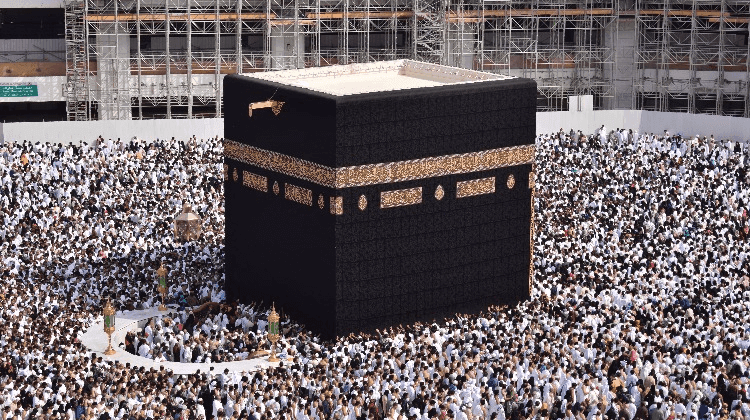
Islam
15,362,882 members
🕋 Spirituality, hadiths, Islamic history and teachings. Connect with fellow members in enlightening conversations as we seek a deeper understanding and appreciation of Islam.
@Salim79599569
Hi
@wandira31667584
help me please🥹💫
@Nawalkhan7
Pakistani men (specially over 50) please don't reach me not here for marriage but here to make some female friends and good sensible male friends for business and hobbies purposes
@Naralk
Women who wear the hijab, be honest: how do you actually feel about the hijab?
I’ve been having a hard time accepting the meaning behind the hijab lately because I don’t feel the same connection to it anymore. Some of us were taught to wear it from a young age, while others were forced to wear it and even yelled at or punished for taking it off. Then these same women in Western countries have adopted specific ways of styling their hijab, like showing parts of their hair, because that’s the only way they can take the hijab off without actually taking it off.
I understand that, in Islam, hijab is considered a religious requirement. But I’ve been struggling with the way it is enforced so heavily in some Muslim countries. We don’t talk enough about the women who are forced to wear it, while Western culture often portrays the hijab as a personal choice. That can feel unfair to women who have never actually been given a choice.
I’ve also been thinking about why so many women, especially women born into Muslim families, seem to struggle with Islam or leave the religion. Sometimes I genuinely understand why they feel that way. There are parts of Islam and Muslim culture that can feel like they benefit men more than women, especially when it comes to the expectations placed on women.
For example, women are expected to cover their bodies, while some men feel perfectly comfortable swimming in public pools, wearing short shorts, or even committing zina, and sometimes their families barely hold them accountable. Yet women can face enormous scrutiny over something as simple as what they wear.
I’m not saying I have all the answers. I’m genuinely struggling with these questions, and I’m trying to understand where these feelings are coming from. A lot about Islam feels unfair to me right now, and I don’t know how to move past that.
@Sajid46226708
“Indeed, in the remembrance of Allah do hearts find rest.” 🤍
Keep your heart connected to Allah,
even when life feels heavy.
Sabr, Salah & Tawakkul. 🤲🏻🌙
@Nakawooya99934887
Hi guys Riyadh people 🍌
Oh Allah heal me and forgive my parents and have mercy on them and guide them and pardon them and gift them and peace and blessings be upon Muhammad and his family
@Zhaaaaa
It’s okay to feel tired. We are still living in this world, after all.
This dunya was never meant to be a place of endless comfort. It comes with trials, heaviness, and moments that make us long for Jannah a place where there is no exhaustion, no hardship, and no sadness.
Be patient. This is only dunya. 😇
@tosifasad
بِسْمِ اللهِ الرَّحْمٰنِ الرَّحِيْمِ
Islamic Literacy: How Do You Actually Know?
Day 15: Does Every Command Mean Obligatory and Every Prohibition Mean Haram?
Someone quotes a verse or Hadith containing “do this” or “do not do this,” then immediately declares: “This is obligatory” or “This is Haram.”
Is the conclusion always automatic?
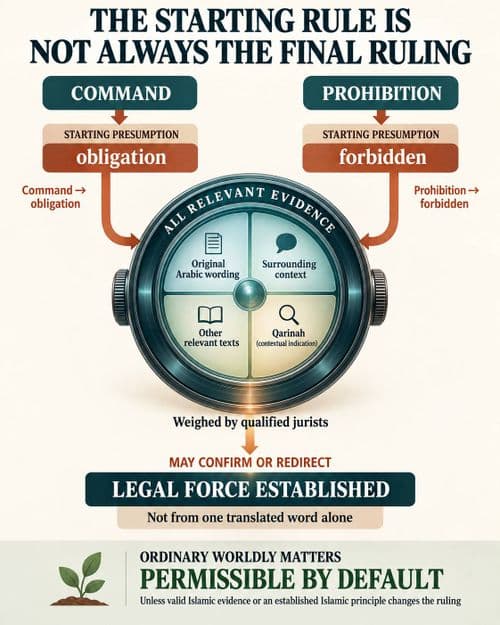
A command or prohibition is serious evidence, but its legal force cannot be decided from one translated word alone.
What Is the Starting Rule?
In Usul al-Fiqh, the principles jurists use to understand Islamic rulings, an amr means a command and a nahy means a prohibition.
A command normally indicates obligation when no other evidence redirects it. A prohibition normally indicates that the act is forbidden.
The Prophet ﷺ said:
“Whatever I have forbidden you, avoid. Whatever I have commanded you, do as much of it as you are able.”
(Sahih al-Bukhari 7288)
However, these are starting presumptions, not necessarily the final rulings.
Why Can the Final Ruling Differ?
Jurists examine the Arabic wording, surrounding passage, other relevant texts and any qarinah, meaning a contextual indication that clarifies what is intended.
A command may indicate recommendation, permission or guidance. A prohibition may indicate dislike or guidance when the evidence requires that understanding.
For example, after discussing the restrictions of Ihram, the sacred state entered for Hajj or Umrah, Allah says:
“When you leave Ihram, then hunt.”
(Qur’an 5:2)
This permits hunting after Ihram. It does not make hunting obligatory.
In Hanafi terminology, a binding prohibition established through strong but non-decisive evidence may be classified as Makruh Tahrimi, meaning prohibitively disliked, rather than Haram. It must still be avoided.
What If There Is No Prohibiting Evidence?
For ordinary worldly things, customs and dealings, the basic rule is permissibility unless a relevant revealed proof or established Islamic principle changes it.
Halal does not require a separate proof naming every new worldly thing. Declaring something Haram requires valid Islamic evidence.
That evidence need not name a modern object word for word. For example, a new intoxicant falls under the established prohibition of intoxicants.
Allah warns:
“Do not falsely declare with your tongues, ‘This is lawful, and that is unlawful.’”
(Qur’an 16:116)
This principle does not override the special rules governing worship, food and slaughter, intimate relations, other people’s rights or proven harm.
What Should an Ordinary Muslim Check?
Before accepting or sharing such a ruling, ask:
- Is the original text really a command or prohibition, or only someone’s translation or summary?
- Have its context and other relevant evidence been considered?
- Is this an ordinary worldly matter or an area with its own special rules?
- Is the conclusion established by qualified jurists, or is it someone’s personal interpretation?
Do not weaken a genuine command into a suggestion. But do not manufacture an obligation or prohibition that Allah and His Messenger ﷺ did not establish.
Allahu a‘lam wa summa Rasūluhu ﷺ a‘lam.
Sources / Further Reading
• Qur’an 5:2 and 16:116
• Sahih al-Bukhari 7288; Sahih Muslim 1337
• Imam al-Sarakhsi, Usul al-Sarakhsi, Chapters on Commands and Prohibitions
• Imam al-Juwayni, al-Waraqat, Commands and Prohibitions
• Imam al-Qarafi, Tanqih al-Fusul, Commands and Prohibitions
• Imam Ibn Qudamah, Rawdat al-Nazir, Commands and Prohibitions
• Imam al-Tabari, Jami‘ al-Bayan, commentary on Qur’an 5:2
• Imam al-Suyuti and Imam Ibn Nujaym, al-Ashbah wa al-Naza’ir, discussions on default permissibility
Next Post
Day 16: General and Specific Wording: Does Every Text Apply to Every Case?
@Hasan71639243
Just like you protect your stomach with diet . Protect your soul from sin