
Tech & Gadgets
93,355 members
Get the latest from the Tech world 🧑💻. Share Insights and discuss the innovations. This is a vibrant community where knowledge and ideas are free flowing!
@rijal
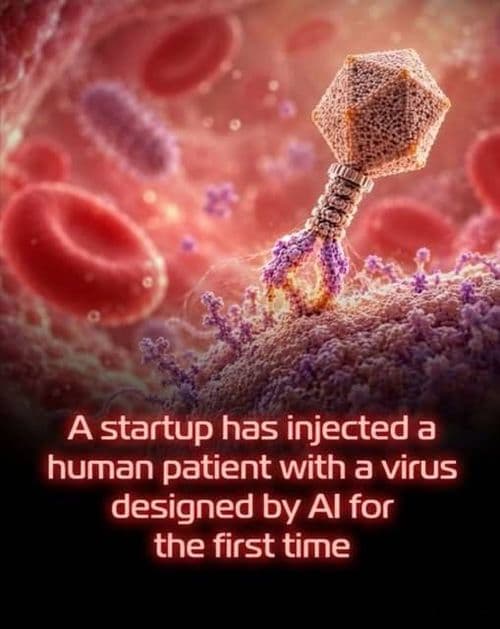
The biotechnology sector has achieved a significant milestone following a public announcement from the California-based startup Radical Numerics regarding the first reported clinical administration of an artificial intelligence-designed virus into a human patient. The therapeutic intervention targeted a highly dangerous, antibiotic-resistant bacterial infection using specialized viruses known as bacteriophages, which are biological entities that selectively infect and destroy bacterial cells rather than human tissue by hijacking the cellular reproduction machinery of the host bacteria until the cell bursts.
While medical science has actively explored the clinical utility of natural phage therapy for nearly a century, the primary innovation in this specific instance involves utilizing computational intelligence to engineer customized viral variants specifically optimized to eradicate a precise, resistant bacterial strain.
Identifying a matching biological phage remains a major challenge because a virus capable of destroying one specific strain of bacteria often proves entirely ineffective against another, a limitation that traditionally forces researchers to manually screen vast, preexisting libraries of natural phages in search of a viable biological match. To circumvent this bottleneck, Radical Numerics developed and trained a proprietary genome language model designated as Omnii-1, utilizing comprehensive genetic sequences alongside historical host-specificity data to efficiently identify, optimize, and synthesize novel viral candidates within a laboratory environment.
Although initial laboratory testing verified that a cocktail containing these computationally modified phage variants successfully eliminated the patient's isolated bacterial sample in vitro, this controlled experiment did not provide definitive confirmation regarding the efficacy or clearance of the infection within a living human subject.
The experimental viral cocktail was subsequently administered to the patient through an authorized, physician-led compassionate-use pathway, a specialized regulatory mechanism reserved exclusively for individuals suffering from severe, life-threatening clinical conditions who have completely exhausted all conventional, standardized treatment options. Citing strict patient privacy protocols, Radical Numerics has not publicly disclosed the final clinical outcome of the treatment, and the initial announcement remains unbacked by a formal, peer-reviewed clinical trial report.
Consequently, while the primary objective of this emerging computational methodology is to dramatically accelerate the development of personalized treatments for multi-drug resistant superbugs, this singular, isolated medical application is insufficient to formally establish the generalized safety or therapeutic efficacy of AI-generated viral therapies.
[Zimmer, C. (2026). Start-Up Claims to Use A.I.-Created Viruses to Treat a Patient. The New York Times. Section Science. ISSN: 0362-4331]
@Hellothereangel
Please can someone tell me how to get rid of the Google bar on my screen? It automatically appeared after an update. I've tried long pressing and dragging it but that doesn't work. Samsung s25 ultra. TIA.

@Khalil1083
AI views on humans
Deeply truthful and frightening
https://www.modelcompare.ai/blog/ai-models-controversial-take-on-humans
@matterdaddy
Is this the best OLED or should I wait? Samsung G7 was my other pick


@fawaz_dev

A Rack Earns Nothing in a Warehouse
https://fawazmk.substack.com/p/a-rack-earns-nothing-in-a-warehouse?utm_source=share&utm_medium=android&r=4kyrxe
@rijal
We’ve said it before, and we’ll keep saying it.
- If your Google account is compromised so are the accounts you used Google to sign in to.
- Google sees and keeps records of every app you sign into, which is just more data being fed to the company who primarily makes money from (your) user data
For those of you thinking "what you should I do instead?":
Make an account with an email alias so if that email address gets compromised/leaked/sold you can just deactivate it and it doesn't link back to your main email address (https://proton.me/pass/aliases).
For those of you wondering how to check where you're signed in with Google and how to stop it:
Go to http://myaccount.google.com/connections (or Security → Your connections to third-party apps & services → See all connections). Filter for “Sign in with Google.” Select any site, then choose Stop using Sign in with Google to revoke access.


Email Aliases keep your real email address private | Proton
https://proton.me/pass/aliases
@Ash254
All dumb questions go to Gemini in my case

@mrh_94
This dark theme isnt what it was hyped up to be lol. Most apps have this feature as standard...